
Mélisse
CHF 35
Life. The scent of honey.
300 grams of Georgian beeswax, a cotton wick, at least 60 hours of light. Each candle is shaped by hand in Georgia, in a wrought-iron mould made for it.
It is then released from the mould with olive oil.
To work in calm in winter after warming your hands above it, to light a table, to rediscover the pleasure of an evening by the flame, alone or with warm company.
Composition: 100% beeswax.
Mélisse takes its name from the ancient Greek Melissa, meaning “bee”.
In the mythology and cults of ancient Greece, the Melissai were priestesses associated with Artemis and Demeter, guardians of the mysteries of Nature and of the fertility of the earth.
For our beeswax candle, this name therefore evokes a return to the ritual of the flame. It also recalls sacred geometry, of which the hexagon of the honeycomb cells is an energetic expression.
Its natural, soothing gentleness answers in harmony the raw strength of the wrought iron of Khvamli. Its liveliness is embraced by the stability of the iron.
Two opposite characters, gathered around the same flame, which serves an important purpose: lighting your true path.
Candle, incandescent bulb and red LED: what should we think?
We advocate a return to the flame. What we have written here is not a catalogue meant to list differences, nor a pamphlet meant to convince you: it is our vision of the world.
We will always fight intellectual laziness, the kind that clouds the ability to see clearly and to choose what is good, the kind that promotes ease, comfort rather than effort, and unfulfilment.
Loïs Kedochim candles have the unique quality of combining the fragrant production of a naturally amber light, rich in infrared, from the combustion of beeswax, without electricity or electronic flicker, without any impure material used in production: no silicone, no paraffin.
| Beeswax candle | Incandescent bulb | Red LED | |
|---|---|---|---|
| Origin of the light | Natural combustion of beeswax | Tungsten filament heated by electricity | Electronic semiconductor |
| Flicker | No flicker. Natural fluctuations, without electrical flashing. | Flicker at 100 - 120 Hz | Flicker, sometimes several thousand Hz |
| Light spectrum | Continuous, rich in infrared | Continuous, rich in infrared | Narrow, concentrated in the red (“red light peak” at 660nm). |
| Visible light | Very warm, amber | Whiter, more short wavelengths | Monochromatic red, very narrow visible spectrum, without the other natural colours. |
| Blue light | Very low | Present, varies with the power | Generally absent for a monochromatic red LED |
| Infrared | Strong emission | Strong emission | Either absent, or a simple light peak at 830 nm. |
| Electricity | None | Required | Required |
| Atmosphere | Living, changing, soft, warm flame | Warm, constant, artificial light | Red light but a cold, artificial atmosphere |
| Materials | Natural beeswax, cotton wick | Glass, metal, tungsten filament | Electronic components |
| Sensory experience | Light, the natural movement of the flame, a subtle scent of honey | Functional lighting | Coloured lighting |
| Our choice | Pure beeswax, no paraffin, no silicone. A true flame, golden and scented with honey, natural, without electronics. | An electrical technology | A red colour |
For more details, the Maison invites you to read the document Le Soleil et l’œuvre de l’Homme. written by Loïs, the founder, after years of receiving questions and suggestions about lighting methods.
1. Understanding flicker: twinkling, flashing.
Modern light sources vibrate at frequencies invisible to the naked eye, but perceived by our nervous system, generating fatigue and stress. You can see it, notably but not only, when you film a screen or a light source with your phone.
- Incandescent bulb: 120 Hz (constant flicker linked to the electrical grid). The Hertz is the unit of a frequency: the bulb "turns on" and "turns off" 120 times per second.
- Red LED: Up to 5400 Hz. Despite its colour, it imposes a "demonic" ultra-fast frequency that breaks the natural calm of the environment.
- The candle: 0 Hz. The fluctuations are not "ON/OFF"; they are slow, chaotic, natural. The human brain prefers natural variability.
The candle is a continuous, stable and soothing light. Fire, combustion, beautiful through its night-time necessity, its rightness and its usefulness. It is not exactly the same as the sun, because the sun would perform nuclear fusion: in theory, according to today's consensus scientific knowledge, in its core, every second, 600 million tonnes of hydrogen are "glued" together to be transformed into 596 million tonnes of helium; and the 4 million tonnes of difference are converted into energy and heat according to E = mc²: this is the energy that reaches us on Earth.
Note that this phenomenon is also continuous, like combustion: there is no flicker - flashing. There is no artificial electricity. No artificial electromagnetism is emitted.
This is why, at Loïs Kedochim, we believe that after the celestial bodies, the pure beeswax candle is the second best lighting in the world, and why we will never go looking for the third.
2. Combustion and alternating current.
Unlike bulbs, which depend on alternating current (AC) and its electromagnetic fields, the candle is a primary combustion source.
It is energy released by matter, not an electronic simulation. We find this difference fundamental, and although we try to explain it here, it cannot be explained, it is felt. For hours.
The candle has this particular quality of creating an organic, true, right atmosphere that electricity could not reproduce.
The advent of the electric light source (and not a thermal source), starting with the creation of the incandescent lamp by Thomas Edison's team in 1879 at Menlo Park, is the major event that tipped human civilisation into industry and productivity, allowing it to build cars at night with Fordism… at the cost of exploding the statistics of diseases that have become modern, diseases of civilisation: cancers, diabetes, neurodegenerative diseases, psychiatric diseases, cardiovascular diseases (heart attack, stroke) and others.
At Loïs Kedochim, we are for performance, but never at the expense of the human being. We are for productivity, but through radiant health, not through biological exhaustion. Not through a mechanical pressure like that of a lemon never renewed.
3. Rare, revealing statistics.
In 1922, Wendell Strong left us an observation.
Cancers were very uncommon in the years 1880-1900. According to the statistics we can only just obtain, in most developed countries of the time (United States, Europe), at that time they would have affected approximately 0.5% of the population, ranked eighth among the causes of death (less than 4% of the causes of death), they caused about 49 cancer deaths a year per 100,000 inhabitants in twenty large American cities in 1881-1885, and 69 deaths a year per 100,000 inhabitants in twelve European countries in 1896-1900. Simply remember the figures of about 50-70. Out of 100,000.
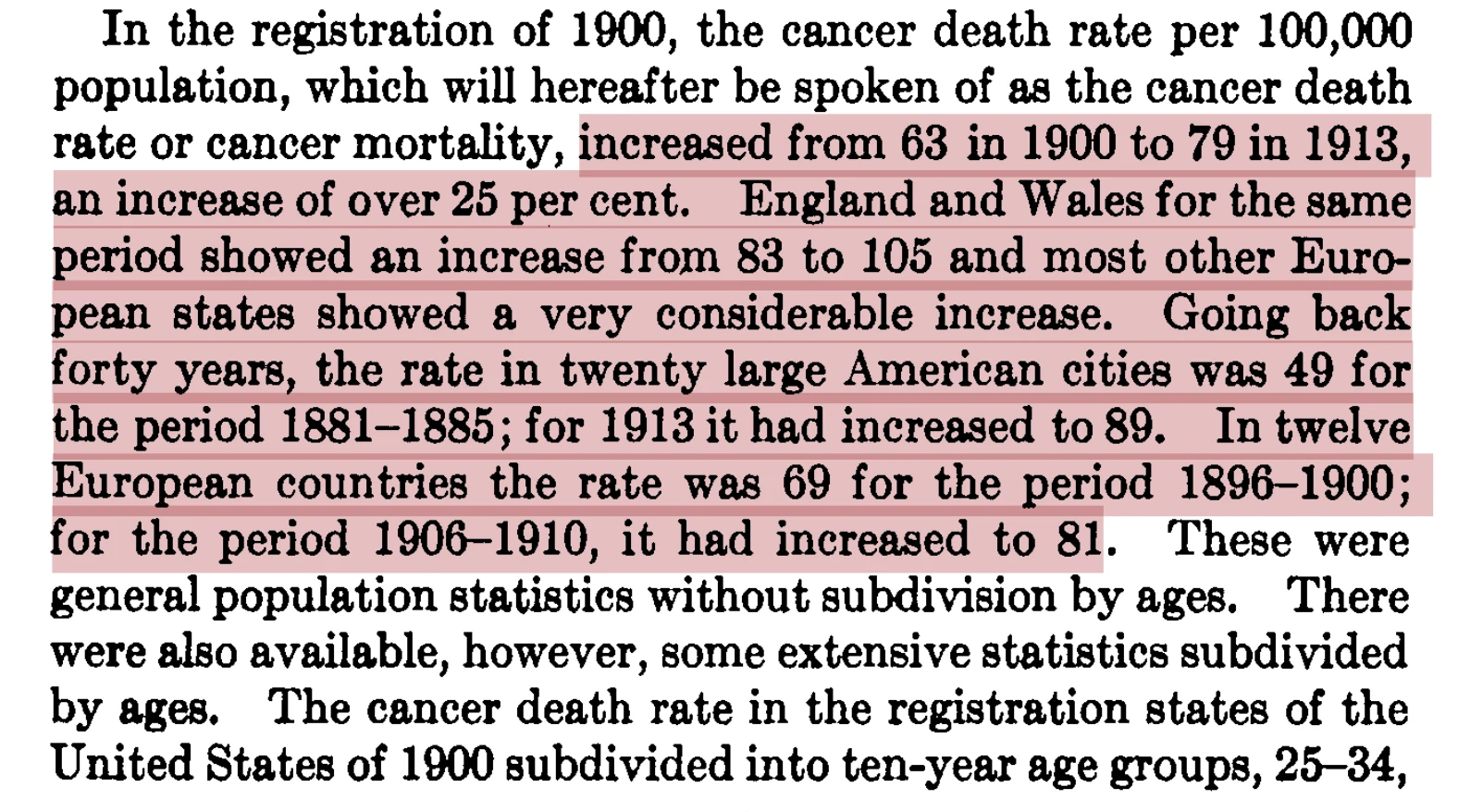
In 1913, this rate had already climbed to 89 cancer deaths a year per 100,000 inhabitants in the same twenty large American cities. It kept rising.

At that time, the only major invention was electric lighting. The others, although important, shared nothing of its spread, its massive adoption by the general population, and its impact on the circadian rhythm and our fundamental electromagnetic coherence.
The only one that could be set against it is simply the consequence of night-time electric lighting, and so of massive industrialisation: the advent of cars, reinforcing a sedentary life, the disconnection from the Earth, and the gradual disconnection from sunlight.
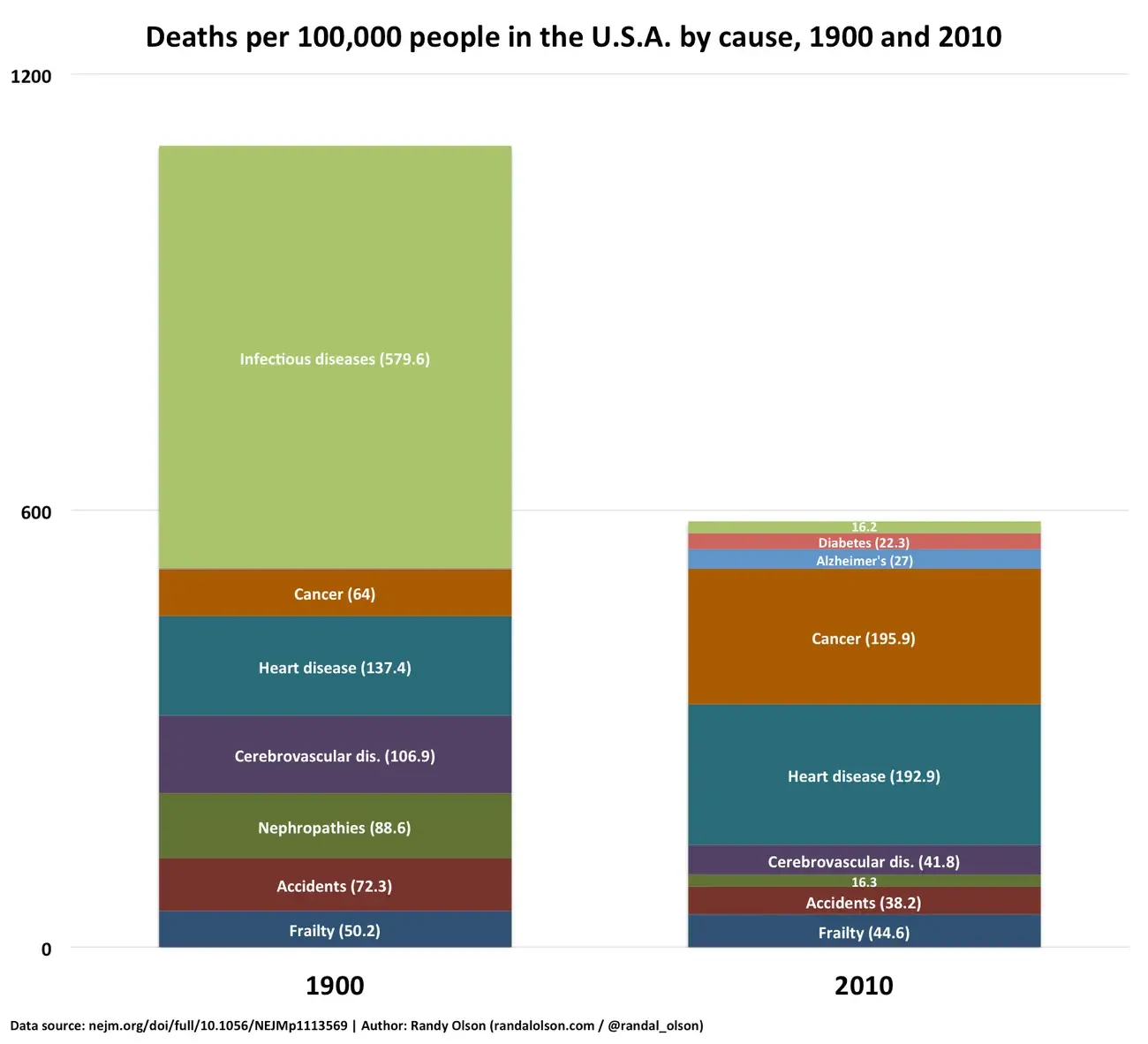
Today, cancers would be the second cause of death in the United States (about 20% of the causes of death), and are often the first cause in many developed countries; they would affect 5% of the population. In 2010, so already many years ago, they already represented 196 cancer deaths a year per 100,000 inhabitants of the general population in the United States. 4 times more cancer deaths in 2010 than a little over a hundred years earlier. Today, a single day in a modern hospital reminds us of the fragility of life, of the omnipresence of this sword of Damocles, and this regardless of the so-called “ageing of the population” and “improvement in diagnostic performance”, if we choose to truly open our eyes and then to believe them.
4. The candle is the warmest and most continuous spectrum in History.
Incandescent light is praised for its warmth, but the flame goes even further into the infrared spectrum, does not depend on artificial electricity, emits no artificial electromagnetic waves, does not flicker, and has always brought human beings together.
The physical temperature of the flame is 1000–1400 °C, higher than an incandescent filament).
Its continuous spectrum comes from the incandescence of carbon particles (hot soot) and emits weak combustion lines (Na, CH, C₂)
This means: no spectral “break”, no missing zone in the deep red, and excellent rendering of skin tones, wood, stone
Let us also learn the definition of a black body. It is an object that absorbs all the light it receives and which, when it is hot, emits light whose spectrum depends only on its temperature. In physics, the black body is the absolute reference for light and heat. It so happens that the candle is closer to a real black body than all modern LEDs.
4. The candle comes from a warm heritage engraved in our DNA
The candle reconnects us with human history. Since the mastery of fire, our eyes and brains have been programmed to relax in front of a flame, and in particular to talk with each other. Fire has (almost) always brought humans together. But, as I have said in many talks and podcasts, the mastery of fire remains an event that marks the beginning of human emancipation from the night.
Prolonged exposure to a fire obviously delays falling asleep, unlike total or near-total darkness (moons, stars). Thus, our Maison's candles are a perfect tool to light yourself with practicality, refinement and health, and to bring human beings closer together, but they remain inferior to darkness as far as your real physical health is concerned - excluding the social side of health.
In the end, choosing the candle means rejecting the aggression of high frequencies to find again the only light source almost aligned with our biology.
The only light sources perfectly aligned with our biology remain the celestial bodies.
"Like the wasps, before I finally went into winter quarters in November, I used to resort to the north-east side of Walden, which the sun, reflected from the pitch pine woods and the stony shore, made the fireside of the pond; it is so much pleasanter and wholesomer to be warmed by the sun while you can be, than by an artificial fire. I thus warmed myself by the still glowing embers which the summer, like a departed hunter, had left."