
Nabadi
Slowly handmade in Georgia.
Seven pieces available for this opening.
If several bank transfers are made for the last available piece, the amount paid will of course be refunded in full to the buyers who cannot obtain it.
After you place your order, we will personally contact you to discuss your measurements and wearing preferences—close-fitting, looser, or longer—and, if you agree, a photograph will help us refine the adjustment.
CHF 400
The mountain against the cold.
In a village in Kakheti, two weeks of hand knitting, after five decades of experience, for a single sweater, from the wool of Tushuri sheep from the high Georgian mountains.
Dense, thick, natural, no contact with chemicals. The best of windbreakers, and yet, paradoxically, breathable in April.
The ally of thousands of repetitions outdoors, of thoughtful walks at -15°C.
No need for a coat.
100% Georgian Tushuri wool.
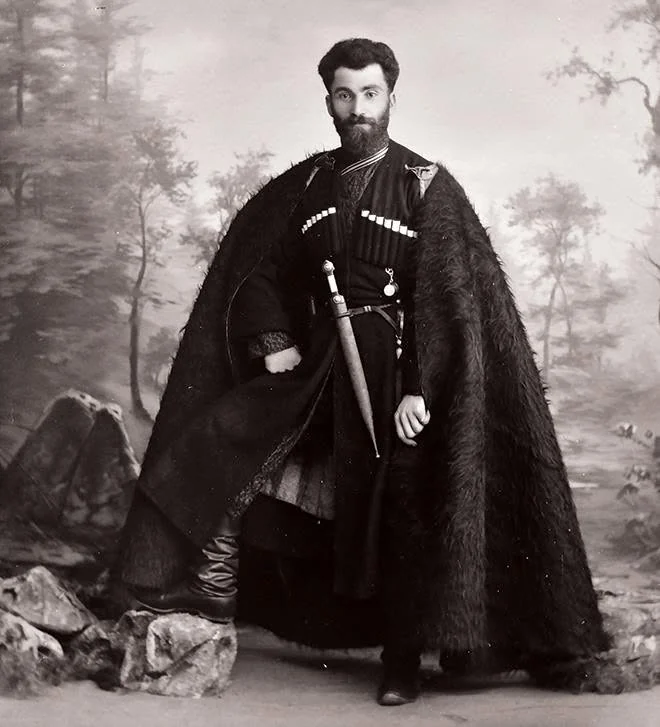
The Nabadi is the iconic, intimidating traditional Georgian cloak. To recall its obvious material would be a pleonasm. Made for shepherds, riders and warriors, it allowed them to face the violence of storms and of men.
Our Nabadi is true armour. A raw, noble strength, nomadic yet a builder. A telluric rampart, absolute protection against the hostility of the Matrix.
Warm, sturdy, the Nabadi smells wonderful.
It comes straight from high, cold mountains that warm the heart.
Mountains that connect us, no one knows how, to our source.
This sweater was knitted entirely by hand, over fourteen days, by a craftswoman experienced in wool, in a village in Kakheti, from the wool of Tushuri mountain sheep, an ancient breed. We sometimes have to make the same sweater again several times to get the perfect result. Our first prototype took five attempts.
To withstand the cold of the Caucasus, the wind above all, the wool of Tushuri sheep is thick and extremely resistant. The fibre is dense and breathable. The wool is washed in clear water, then carded and spun by traditional methods, with nothing chemical added. Each sweater is knitted entirely by one person, from start to finish.
A truly strong piece, and a beneficial one too: my friends and their families told me that they wear pieces made from this wool around the chest when they have “water in the lungs” (heart failure), and around the legs to treat prostate problems, with trousers made for this purpose. This is not medical advice: I am simply sharing what people have told me. A sweater that smells of Nature, on which your cat would fall asleep if you left it on the sofa.
ASMR for the skin, the natural character of this wool allows optimal thermoregulation: it protects from the wind and keeps you warm, but, unlike artificial materials, without ever giving a sudden rush of heat, which is why I also wear it in March, for example, while it is also my best ally in the mountain -15°C of January.
Perfect for starting a workout, the absence of a zip lets you warm your neck and work your muscles touching wool, not metal. No need for a coat.
Hand washing is recommended, in cold or lukewarm water, with a mild, natural soap. The sweater will usually keep most of its qualities in the machine, but hot temperatures are not advised: if you choose to do so, then at least choose a cold wash to avoid large temperature differences between washing and rinsing. It is this temperature difference that really damages such pieces. Choose a natural detergent without enzymes. You can wash this sweater in clean snow, simply by rubbing it gently in cold water. Snow purifies the wool without damaging it, tightens its fibres and preserves its warmth, its softness and its durability.
Nabadi is a unisex sweater.
A word about the village where this sweater is made.
The main livelihood of the people of this village in Kakheti is farming. Traditional practices such as growing potatoes and raising sheep thrive there. The local state farm specialises in breeding Tushuri sheep, a breed renowned worldwide for its resilience and its high-quality wool. But, more than a simple farming village, this mountain region plays a central role in preserving the surrounding natural areas, by coordinating the management of a national park known for its rare biodiversity and its appeal to researchers and travellers from all over the world.
A word about my love for the mountains.
In 2018, I did a great deal of trail running. My uncle had given me « Le dictionnaire amoureux de la montagne » for Christmas, 1,026 pages, and I read most of it. I dreamed of escape; I was in my fifth year of medicine. 7 years later, when I booked my one-way plane ticket to Georgia, I knew where I would go first. People do not know all the reasons why I came. Here, it is a return to the source, in every sense of the word. My ancestors travelled, I know it from the facts, and some spent centuries in mountains like these, I know it in my blood. I booked my first lodging for three months, then I stayed, although I will still travel in this magnificent country and around it. These mountains are high, pure, true, immense, strong, dangerous; you are alone, absolutely alone, when you venture into them. There is almost no tarmac, no tourist chalet outside a few known areas, just villages, a few roads, and a slow life. The water, where I go, is completely pure; and all the money of Dubai could not bring that to such places. I spend my life with dogs, horses, cows, donkeys, cats, I rarely hear wolves at night (they attack the sheep; so the villagers build good shelters and have dogs that could each eat three wolves), I see birds of prey (but without my glasses, they see me better). The mountain used to be my sports ground; it has often become a place of delightful life. Some things cannot be explained, they are felt in a few moments with absolute certainty. When I go to town, a friend's mother tells me « But stay here » (at their home), and I answer her in Georgian « My village, my heart ».